Think on sustainability through Edo era in Japan, Kimono and Mai-Ohgi (Japanese dance fan) |
Performance Lab, seminar in the Summer semester 2022
MA Choreography, HZT Berlin (Inter-University Centre for Dance Berlin ),
, with Prof.Susanne Vincenz
This WS was based on my lecture performance at Humboldt Forum, Museum für Asiatische Kunst, curated by Emanuele Valariano. Searching and sharing dance or music culture live in me, turned to became an eye-opening counter-action towards my own decades of practice of the western style of performing arts; Musical, Music & Dance shows, Tanztheater and among others. The main theme ‘sustainability’ is a crucial theme, and it was very inspiring to work with the young artists / MaC students, with whom I could touch such global theme in personal yet international level. And the venue Floating University Berlin influenced on our state of mind thinking of the past, present and future of the world.
Documentation
20.06. What to learn from Edo-Period (1603 – 1868) in Japan?
The Edo Shogunate in the 17. -19. centuries in Japan, country had once practiced a Japan centred, circular economy system.
Theme of the day was introduce Kimono culture and the ecological living stile in Edo- Shogunate. Today Japan has a high degrees of dependance of imports for almost everything, from the vegetables to medicine. And since the Putin-War began as well as the Chinese military stressing the Taiwan, Japanese are first ever seriously concerning of the means of transport.
The international MaC students (Germany and Brazil) introduced their own culture and we discussed further.
– What we can learn (or find similarity ) from the people’s life of the time?
– How was the life in Europe and south America before the industrial revolution?
30. June -1 | Kimono and its form – Paper Kimono
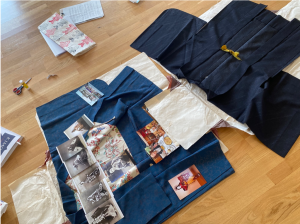
What is the ecological function of the pattern of Kimono? Traditionally Kimono is made with the textile with its wides as 36-38cm and length of 12m. Since the resources were limited, Kimono was designed to be able to undo all the seams to bring it back to a textile, to refresh the material and to refurbish into different sizes and colours. To understand this simple pattern of Kimono, we made a miniature Kimono out of a 7.8cm paper roll (Kassenroll).
30. June -2 | Kimono and its form
Where comes the movement? How much our movement is shaped by what we wear? Compare with European costumes, you can feel the lower center of gravity at wearing a Kimono. Also during the Edo period, Obi(帯), the broad sash(belt) for Kimono became a main fashion item, Obi became thicker and wider. We wore Obi and underwear of Kimono and I introduced some of the basic movement of Nihon-Buyoh(日本舞踊).
June -3 | Movement of Mai-Ohgi Mai-Ohgi
The Japanese folding dance fan is a spirit of Japanese classical dance. There are various folding-fan in East-Asian countries. It is still a Japanese custom to carry a fan on formal occasions when dressed in the traditional Japanese costume Kimono. We have picked up the folding fan and practiced the aesthetics of Mai-Ohgi, which always use gravity and air resistance are based on dynamics.
01. July | self study, revision and showing : Movement of Mai-Ohgi
The task was dance with/without the folding fan, use the idea and function of Mai-Ohgi as a stimuli for Improvisation. I requested using European music composed in the same period with Edo-Shogunate (17.-19. centuries). In the afternoon we went through the topics of the last two days, then students showed the outcome of their self study, the movement of Mai-Ohgi with the music composed in the 17.-19. centuries. I have truly enjoyed their spontaneity and creativity playing around the Mai-Ohgi.
Link : https://vimeo.com/744825496/22ccfc4133
08. July |
Last day
I joined Dr. Christiane Berger, Prof. Nik Haffner and Prof. Ingo Reulecke to observe the students’ showing, their self discovery of the last three weeks at Floating University.
Thank you for MA Students |
Stefanie A., Kysy A. F., Salome K.,
Leonie N. B., Mariana R. S.